
Recommended Reading
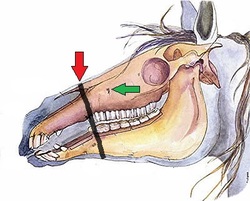
Choosing the best Bitless Bridle for your horse by Cynthia Cooper
Over the past 5 or 6 years bitless bridles have increased in popularity and so have the number of available designs.
Like bits, they can have very different actions and levels of comfort for the horse, so choosing a bitless bridle comes down to knowing how the designs work and what may be best for your individual horse.
In some cases, even the activity/event you participate in, will indicate a design that is more suited, eg. a rope bridle would not be accepted in the showring but it suits endurance and trail riding very well.
So first we need to know how bitless bridles work in general.
All bitless bridles apply pressure somewhere on the horse's head, and often in more than one place.
The top of the nose, side of the nose, cheeks, poll and under the jaw are the main areas contacted when a rider uses the rein, so lets look at the affect this has on the horse.
Click here to read the rest of this article.
Over the past 5 or 6 years bitless bridles have increased in popularity and so have the number of available designs.
Like bits, they can have very different actions and levels of comfort for the horse, so choosing a bitless bridle comes down to knowing how the designs work and what may be best for your individual horse.
In some cases, even the activity/event you participate in, will indicate a design that is more suited, eg. a rope bridle would not be accepted in the showring but it suits endurance and trail riding very well.
So first we need to know how bitless bridles work in general.
All bitless bridles apply pressure somewhere on the horse's head, and often in more than one place.
The top of the nose, side of the nose, cheeks, poll and under the jaw are the main areas contacted when a rider uses the rein, so lets look at the affect this has on the horse.
Click here to read the rest of this article.
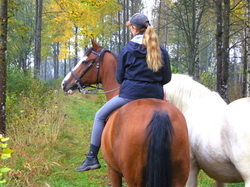
Bitless Riding Differences By Cynthia Cooper.
Confident riders and educated horses adapt to riding bitless easily.
When riding with a bitless bridle, there are some perceived, and a couple of real differences to riding with a bit that will help with your transition and training.
Confident riders and well educated horses who have a good basic foundation generally won’t have a problem adapting to a bitless bridle because essentially the principles are the same – ride with your mind and seat first, then legs and hands second, keeping the feel soft and light.
But if you lack confidence or knowledge and are not riding a responsive educated horse, here are some things that will help your bitless Click here to read more.....
Confident riders and educated horses adapt to riding bitless easily.
When riding with a bitless bridle, there are some perceived, and a couple of real differences to riding with a bit that will help with your transition and training.
Confident riders and well educated horses who have a good basic foundation generally won’t have a problem adapting to a bitless bridle because essentially the principles are the same – ride with your mind and seat first, then legs and hands second, keeping the feel soft and light.
But if you lack confidence or knowledge and are not riding a responsive educated horse, here are some things that will help your bitless Click here to read more.....
Bitless Bridles - What's the Difference: by Cynthia Cooper
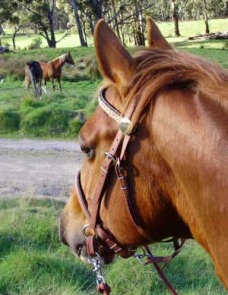
Until a few years ago there used to be very few choices if you wanted to ride without a bit in your horse’s mouth.
There was the western style bosal, the mechanical hackamore or the rope halter, mostly used by western riders, showjumpers and endurance riders in that order.
But now, with our awareness that horses don’t need a bit to be controlled, we are faced with a huge choice of bridles that use various means of action to put pressure on the horse.
This article will look at the more readily available options and why they would be used or what purpose they are better suited to.
Click here to read the rest of this article.
How to transition to a Bitless Bridle By Cynthia Cooper
There’s a saying – “Go shoe-less but not clue-less” so here’s another
“Go bit-less but not wit-less”. (I’m sure it's been said before)!
So, you’ve decided to listen to your horse and get rid of the bit. You may have read about or heard of the negative effects a bit can have on a horse, or you may just want to try riding bitless to see if your horse would prefer not to have a lump of metal in his mouth.
Perhaps you’ve ridden for a long time in a rope halter or hackamore and decided it's time to refine things, so a bitless bridle is the next step.
Or maybe you’d like to go out in public or compete without a bit but don’t want to be frowned upon for riding in a halter.
Whatever the reason, there are some things you can do to make the transition to using a bitless bridle smooth and safe for you and your horse.
Click here to read the rest of this article.
Riding Bitless - 'On the Bridle' By Cynthia Cooper
The term 'on the bit' has become commonplace and used to denote a certain frame or level of head carriage and collection of the horse.
But what happens when you don't have a bit in your horse's mouth? Can your horse still collect and if they do, what can you call it? Well - since 'on the bit' means acceptance, collection and responsiveness to the bit, maybe 'on the bridle' can refer to those same qualities when a horse wears a bitless bridle.
After all, we are still looking for acceptance, softness, responsiveness and collection in the horse for the purpose of easily carrying a human during intense periods of collected exercise such as in dressage, show hack classes, jumping, reining and many other competitive events of short duration.
Click here to read the rest of this article.
Get Better Bitless Control by Moving the Hind End by Cynthia Cooper
Control (or lack of it) seems to be one of the big fears' riders face when starting to ride bitless. For me as a natural horsemanship devotee, it wasn’t an issue at all because the program I followed developed control on the ground that translated directly to the saddle.
I came to appreciate that hindquarter control was most important, especially when I was riding with a halter and one rein! Click here to read the rest of this article.
Disengagement is a Powerful Control - by Philip Nye
What is disengagement?
Firstly, it's the opposite of engagement or full power as a disengaged horse has relaxed and yielded all its power. It has released its power to the hindquarters mainly but also softened and released its shoulders, head and neck. The horse overall is relaxed, submissive and yielding.
So how do we achieve this?
Disengagement is asked for primarily with the inside leg in conjunction with an indirect rein. An indirect rein therefore becomes a relax, settle down, life out, control rein for downward transitions compared with a direct rein which is a life up, go somewhere communication rein for upward transitions.
Click here to read the rest of this article.
Driving Bitless and Blinkerless by Cynthia Cooper
While driving in a bitless bridle is not seen as often as riding bitless, there are people from all corners of the world doing just that and very successfully.
In fact, if you can ride bitless, why not drive bitless, and blinker-less for that matter!
Click here to read the rest of this article.
Bitless Bridle Experiment and Revelation
On 31 October 2008, during the annual conference of the Certified Horsemanship Association (CHA) held at the Kentucky Horse Park, Dr. Robert Cook, a research veterinarian, gave a demonstration of relevance to the improvement of welfare and safety for horses and humans.
The demonstration took the form of a scientific experiment in front of witnesses. Four volunteers, all of whom were CHA certified riding instructors, rode four horses, offered by owners for the purpose. A four-minute, exercise test was first completed using a bitted bridle (jointed snaffle). Immediately afterwards, the same rider/horse partnership repeated the test using the Bitless Bridle. Prior to the demonstration, none of the horses had ever been ridden in this crossunder design of bitless bridle.
Click here to read the rest of this article.
Bitless Bridles Seen as Safer Alternative for Horses in New Study from www.thehorse.com
Previous studies evaluating the behavioral responses of horses to different types of bridles found that horses perform at least as well, if not better, with a bitless bridle than a jointed snaffle.
Click here to read the rest of this article.
TRADITION & THE STATUS QUO OR SCIENCE & ADVANCE?
by Robert Cook FRCVS, PhD
Official bodies such as the FEI and a number of racing administrations are aware of my arguments for a rule change to permit use of the crossover bitless bridle, but none have, as yet, agreed to such a change. Their reasons for not doing so do not include any scientific arguments but are based mainly on a wish to retain the status quo. For example, a national federation affiliated to the FEI has recently stated that they follow the lead of the FEI in formulating their rules. They refused repeated requests for a rule change on the grounds that they cannot permit the crossover bitless bridle (CBB) for dressage as this would constitute a rejection of the classical tradition.
The answers provided by this national federation highlight a serious misunderstanding about the proper nature of tradition and represent an unnecessary obstacle to advances in welfare. Not once did they defend the use of the bit on the grounds that it was safer, more efficient or more humane. They simply repeated the explanation that the bit was traditional or classic.
Click here to read the rest of this article.
IS THE BIT REALLY SO CRUEL? An exchange of correspondence with Robert Cook FRCVS, PhD
This article explains it all.
Click here to read the rest of this article.
There was the western style bosal, the mechanical hackamore or the rope halter, mostly used by western riders, showjumpers and endurance riders in that order.
But now, with our awareness that horses don’t need a bit to be controlled, we are faced with a huge choice of bridles that use various means of action to put pressure on the horse.
This article will look at the more readily available options and why they would be used or what purpose they are better suited to.
Click here to read the rest of this article.
How to transition to a Bitless Bridle By Cynthia Cooper
There’s a saying – “Go shoe-less but not clue-less” so here’s another
“Go bit-less but not wit-less”. (I’m sure it's been said before)!
So, you’ve decided to listen to your horse and get rid of the bit. You may have read about or heard of the negative effects a bit can have on a horse, or you may just want to try riding bitless to see if your horse would prefer not to have a lump of metal in his mouth.
Perhaps you’ve ridden for a long time in a rope halter or hackamore and decided it's time to refine things, so a bitless bridle is the next step.
Or maybe you’d like to go out in public or compete without a bit but don’t want to be frowned upon for riding in a halter.
Whatever the reason, there are some things you can do to make the transition to using a bitless bridle smooth and safe for you and your horse.
Click here to read the rest of this article.
Riding Bitless - 'On the Bridle' By Cynthia Cooper
The term 'on the bit' has become commonplace and used to denote a certain frame or level of head carriage and collection of the horse.
But what happens when you don't have a bit in your horse's mouth? Can your horse still collect and if they do, what can you call it? Well - since 'on the bit' means acceptance, collection and responsiveness to the bit, maybe 'on the bridle' can refer to those same qualities when a horse wears a bitless bridle.
After all, we are still looking for acceptance, softness, responsiveness and collection in the horse for the purpose of easily carrying a human during intense periods of collected exercise such as in dressage, show hack classes, jumping, reining and many other competitive events of short duration.
Click here to read the rest of this article.
Get Better Bitless Control by Moving the Hind End by Cynthia Cooper
Control (or lack of it) seems to be one of the big fears' riders face when starting to ride bitless. For me as a natural horsemanship devotee, it wasn’t an issue at all because the program I followed developed control on the ground that translated directly to the saddle.
I came to appreciate that hindquarter control was most important, especially when I was riding with a halter and one rein! Click here to read the rest of this article.
Disengagement is a Powerful Control - by Philip Nye
What is disengagement?
Firstly, it's the opposite of engagement or full power as a disengaged horse has relaxed and yielded all its power. It has released its power to the hindquarters mainly but also softened and released its shoulders, head and neck. The horse overall is relaxed, submissive and yielding.
So how do we achieve this?
Disengagement is asked for primarily with the inside leg in conjunction with an indirect rein. An indirect rein therefore becomes a relax, settle down, life out, control rein for downward transitions compared with a direct rein which is a life up, go somewhere communication rein for upward transitions.
Click here to read the rest of this article.
Driving Bitless and Blinkerless by Cynthia Cooper
While driving in a bitless bridle is not seen as often as riding bitless, there are people from all corners of the world doing just that and very successfully.
In fact, if you can ride bitless, why not drive bitless, and blinker-less for that matter!
Click here to read the rest of this article.
Bitless Bridle Experiment and Revelation
On 31 October 2008, during the annual conference of the Certified Horsemanship Association (CHA) held at the Kentucky Horse Park, Dr. Robert Cook, a research veterinarian, gave a demonstration of relevance to the improvement of welfare and safety for horses and humans.
The demonstration took the form of a scientific experiment in front of witnesses. Four volunteers, all of whom were CHA certified riding instructors, rode four horses, offered by owners for the purpose. A four-minute, exercise test was first completed using a bitted bridle (jointed snaffle). Immediately afterwards, the same rider/horse partnership repeated the test using the Bitless Bridle. Prior to the demonstration, none of the horses had ever been ridden in this crossunder design of bitless bridle.
Click here to read the rest of this article.
Bitless Bridles Seen as Safer Alternative for Horses in New Study from www.thehorse.com
Previous studies evaluating the behavioral responses of horses to different types of bridles found that horses perform at least as well, if not better, with a bitless bridle than a jointed snaffle.
Click here to read the rest of this article.
TRADITION & THE STATUS QUO OR SCIENCE & ADVANCE?
by Robert Cook FRCVS, PhD
Official bodies such as the FEI and a number of racing administrations are aware of my arguments for a rule change to permit use of the crossover bitless bridle, but none have, as yet, agreed to such a change. Their reasons for not doing so do not include any scientific arguments but are based mainly on a wish to retain the status quo. For example, a national federation affiliated to the FEI has recently stated that they follow the lead of the FEI in formulating their rules. They refused repeated requests for a rule change on the grounds that they cannot permit the crossover bitless bridle (CBB) for dressage as this would constitute a rejection of the classical tradition.
The answers provided by this national federation highlight a serious misunderstanding about the proper nature of tradition and represent an unnecessary obstacle to advances in welfare. Not once did they defend the use of the bit on the grounds that it was safer, more efficient or more humane. They simply repeated the explanation that the bit was traditional or classic.
Click here to read the rest of this article.
IS THE BIT REALLY SO CRUEL? An exchange of correspondence with Robert Cook FRCVS, PhD
This article explains it all.
Click here to read the rest of this article.
- Why the LightRider Bitless Bridle is Better For Endurance
- To Bit or Not to Bit by Janene Clemence details the damage bits can cause to horses.
- To Bit or Not To Bit by Dr Amanda Warren-Smith looks at the responses of young horses to bitted and bitless bridles during foundation training.
